By: Sid Peddinti, Esq.
Nonprofit Lawyer. Tax Researcher. Legal Publisher.
Navigating the complex landscape of Internal Revenue Service (IRS) tax codes for private foundations is critical for maintaining tax-exempt status and ensuring philanthropic impact.
These regulations, primarily found in Internal Revenue Code (IRC) Chapter 42, are designed to prevent abuse and ensure that foundation assets are used exclusively for charitable purposes, distinguishing private foundations from public charities.
Let’s explore these in more depth.
Key Takeaways
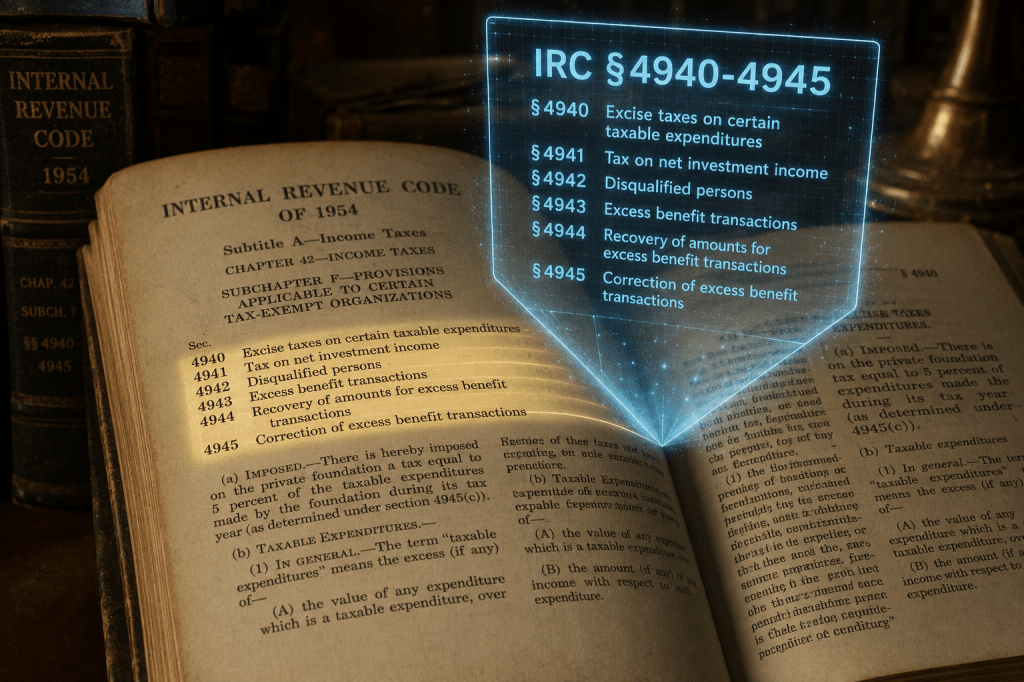
- Private foundations are exempt under IRC Section 501(c)(3) but are subject to specific excise taxes under IRC Sections 4940-4945 to prevent misuse of funds.
- For the 2026 tax year, private foundations face a 1.39% excise tax on their net investment income under IRC Section 4940.
- Strict rules prohibit “self-dealing” transactions between a foundation and “disqualified persons” under IRC Section 4941, carrying substantial penalties.
- Foundations must distribute at least 5% of their net investment assets annually to avoid excise taxes under IRC Section 4942.
- Limitations on “excess business holdings” (IRC Section 4943) prevent foundations from controlling commercial enterprises.
- “Jeopardizing investments” (IRC Section 4944) are prohibited, requiring prudent management of assets.
- “Taxable expenditures” (IRC Section 4945), such as lobbying or non-approved grants, trigger significant penalties.
- Correcting non-compliance within specified periods is crucial to mitigate or avoid additional, more severe penalties.
Table of Contents
- IRC Section 501(c)(3) – Foundational Tax-Exempt Status
- IRC Section 4940 – Tax on Net Investment Income
- IRC Section 4941 – Taxes on Self-Dealing
- IRC Section 4942 – Taxes on Failure to Distribute Income
- IRC Section 4943 – Taxes on Excess Business Holdings
- IRC Section 4944 – Taxes on Investments Which Jeopardize Charitable Purpose
- IRC Section 4945 – Taxes on Taxable Expenditures
- Reversing Non-Compliance and Correction Periods
- References
IRC Section 501(c)(3) – Foundational Tax-Exempt Status
The Concept
Internal Revenue Code (IRC) Section 501(c)(3) is the fundamental provision that grants federal tax-exempt status to organizations operated exclusively for charitable, religious, educational, scientific, literary, testing for public safety, fostering national or international amateur sports competition, or preventing cruelty to children or animals.
Private foundations, by definition, fall under this umbrella but are distinguished from “public charities” by their funding sources, typically receiving primary support from a single source like an individual, family, or corporation rather than the general public (individuals, corporations, foundations, nonprofits, or government agencies). This distinction subjects them to a more stringent regulatory framework and a series of excise taxes designed to prevent abuse and ensure assets are used for charitable purposes.
Why It Matters
Achieving and maintaining 501(c)(3) status is paramount for any charitable organization, including private foundations, as it confers federal income tax exemption on mission-related revenue and allows donors to deduct contributions on their federal tax returns, which is crucial for fundraising.
Without this status, a foundation would be treated as a taxable entity, severely limiting its ability to attract donations and carry out its charitable mission. The classification as a private foundation, specifically, triggers the applicability of the Chapter 42 excise taxes (IRC Sections 4940-4945), which dictate strict operational guidelines.
How to Apply It
To obtain 501(c)(3) status, a private foundation must file Form 1023, Application for Recognition of Exemption, with the IRS (IRS.gov). Its organizing documents (e.g., articles of incorporation or trust documents) must explicitly limit its purposes to those described in Section 501(c)(3) and contain a dissolution clause ensuring assets transfer to another qualified 501(c)(3) upon dissolution.
Ongoing compliance requires the foundation to operate primarily for exempt purposes, with no more than an insubstantial part of its activities furthering non-exempt purposes (IRS.gov). It must also adhere to annual filing requirements, primarily Form 990-PF, Return of Private Foundation.
- Compliant: A foundation’s articles of incorporation state its purpose is “to provide educational scholarships to underprivileged students” and stipulate that upon dissolution, assets will be distributed to another qualified educational charity (IRS.gov).
- Non-Compliant: A foundation’s governing documents allow it to engage in “any lawful activity,” or do not specify how assets will be distributed upon dissolution, leading to potential rejection of 501(c)(3) status (Wiss, 2026).
IRC Section 4940 – Tax on Net Investment Income
The Concept
IRC Section 4940 imposes an annual excise tax on a private foundation’s net investment income. This tax is distinct from other excise taxes under Chapter 42, as it applies every year regardless of any prohibited acts, targeting the income generated from the foundation’s investments. For the 2026 tax year, the rate is a flat 1.39% for private foundations. This flat rate replaced a two-tier system to simplify compliance.
Why It Matters
This tax is a routine but significant financial obligation for nearly all endowed private foundations. Failure to properly calculate, report, and pay this tax can result in penalties, including those for missed estimated payments. It directly reduces the funds available for charitable distributions, making accurate calculation and strategic management of investment-related expenses crucial.
How to Apply It
Net investment income is calculated as the sum of gross investment income (e.g., interest, dividends, rents, royalties, and net capital gains from investment property) minus allowable ordinary and necessary expenses incurred for the production or collection of that income (IRS.gov). Allowable expenses include investment management fees, legal and accounting fees related to investments, and other direct costs. General operating expenses of the foundation, such as staff salaries for program work, are generally not deductible against investment income unless they are directly attributable to investment activities. Foundations must report this tax on Form 990-PF and are typically required to make quarterly estimated tax payments if the expected tax is $500 or more.
- Compliant: A foundation accurately calculates its net investment income, deducts appropriate investment management fees, and pays its 1.39% excise tax (IRS.gov).
- Non-Compliant: A foundation fails to pay quarterly estimated taxes for its net investment income, or incorrectly deducts program-related operating expenses against investment income, leading to underpayment and penalties.
IRC Section 4941 – Taxes on Self-Dealing
The Concept
IRC Section 4941 prohibits “self-dealing” transactions between a private foundation and “disqualified persons.” These rules are among the most stringent and are designed to prevent the diversion of a foundation’s assets for the private benefit of individuals closely associated with it, regardless of whether the transaction appears fair or even beneficial to the foundation. Disqualified persons include substantial contributors, foundation managers, owners of more than 20% of a business that is a substantial contributor, and their family members, as well as certain government officials.
Why It Matters
Self-dealing is a “no-fault” violation, meaning intent is irrelevant; the mere occurrence of a prohibited transaction triggers excise taxes. Penalties are substantial, impacting both the disqualified person(s) and foundation managers who knowingly participated. These rules are critical for maintaining public trust and ensuring the foundation’s assets remain dedicated to its charitable mission.
How to Apply It
Prohibited self-dealing acts include, but are not limited to:
- Sale, exchange, or lease of property between a private foundation and a disqualified person.
- Lending of money or other extension of credit between a private foundation and a disqualified person (with some exceptions for interest-free loans from a disqualified person to a foundation).
- Furnishing of goods, services, or facilities between a private foundation and a disqualified person, unless without charge to the foundation and used exclusively for exempt purposes, or on a basis no more favorable than to the general public and functionally related to the foundation’s exempt purpose.
- Payment of excessive compensation or reimbursement of expenses by a foundation to a disqualified person.
- Transfer to, or use by or for the benefit of, a disqualified person of the income or assets of a private foundation.
The initial excise tax for 2026 is 10% of the amount involved, imposed on the disqualified person. A foundation manager who knowingly participated faces an initial 5% tax (capped at $20,000 for any one act against a manager). If the act is not corrected, a severe 200% additional tax applies to the disqualified person, and a 50% additional tax to the manager. Correction typically involves undoing the transaction to the extent possible and making the foundation whole.
- Compliant: A private foundation purchases office supplies from a non-disqualified vendor through a competitive bidding process (IRS.gov). A disqualified person provides legal services to the foundation without charge.
- Non-Compliant: A foundation leases office space from a building owned by a substantial contributor (a disqualified person) at fair market value (IRS.gov). This is an act of self-dealing, even if the terms are favorable to the foundation. A foundation manager receives excessive compensation for services provided (IRS.gov).
IRC Section 4942 – Taxes on Failure to Distribute Income
The Concept
IRC Section 4942 mandates that private foundations distribute a minimum amount of their assets annually for charitable purposes.
This is known as the Minimum Distribution Requirement (MDR) and is designed to prevent foundations from indefinitely accumulating wealth without making charitable distributions. For 2026, private foundations must distribute at least 5% of the fair market value of their net investment assets (which .
Why It Matters
Failure to meet the MDR can result in significant excise taxes. This rule ensures that a foundation’s wealth is actively used to further its exempt purposes, thereby benefiting the public rather than simply existing as an endowment. This is one of the most operationally critical rules for grant-making foundations.
How to Apply It
The “distributable amount” is calculated by taking 5% of the average fair market value of the foundation’s non-charitable assets (assets not used directly in carrying out exempt purposes), minus taxes paid under Section 4940. “Qualifying distributions” that count toward the MDR include direct payments for charitable purposes, grants to public charities, and expenses paid to acquire assets used directly in carrying out exempt purposes.
Excess qualifying distributions can be carried forward for five subsequent tax years (EY, 2026). Initial failure to meet the MDR results in a 30% excise tax on the undistributed amount. If uncorrected within the taxable period, an additional 100% tax is imposed (IRS.gov). Correction involves distributing the shortfall as qualifying distributions within the allowable correction period. Exceptions exist for “private operating foundations” and in cases of incorrect asset valuation that were not willful and due to reasonable cause (IRS.gov).
- Compliant: A foundation with $20 million in average investment assets in 2026 and $40,000 in Section 4940 taxes distributes at least $960,000 in qualifying grants or direct charitable expenses ($20M * 5% – $40K Taxes).
- Non-Compliant: A foundation fails to distribute the required 5% of its assets. An initial 30% tax is imposed on the undistributed amount. If not corrected, a 100% additional tax is levied (IRS.gov).
IRC Section 4943 – Taxes on Excess Business Holdings
The Concept
IRC Section 4943 limits the extent to which a private foundation, together with all disqualified persons, can own interests in a “business enterprise.” The intent is to prevent foundations from controlling commercial businesses unrelated to their charitable mission and to ensure their assets are dedicated to philanthropy rather than profit-making.
Why It Matters
These rules prevent foundations from becoming entangled in business operations, which could divert management’s attention and resources from charitable activities or lead to conflicts of interest. Significant penalties apply if excess holdings are not divested.
How to Apply It
Generally, a private foundation and all disqualified persons combined may not own more than 20% of the voting stock in a corporation or a similar interest in other business enterprises (e.g., profits interest in a partnership). An exception allows for up to 35% ownership if a third party, who is not a disqualified person, has “effective control” of the business.
A “de minimis” rule exempts holdings of 2% or less of voting stock and value, regardless of disqualified person ownership.
Excess business holdings acquired other than by purchase (e.g., through a bequest) are treated as held by a disqualified person for a five-year period, allowing time for disposition. An initial excise tax of 10% of the value of the excess holdings is imposed. If not corrected within the taxable period, an additional 200% tax is applied. Correction involves disposing of the excess holdings to a person who is not a disqualified person.
- Compliant: A private foundation holds 15% of the voting stock in a manufacturing company, and no disqualified persons hold any stock in that company. Or, the foundation holds 30% of the voting stock, but an independent board of directors (non-disqualified persons) has effective control.
- Non-Compliant: A family foundation owns 25% of the voting stock of the family business, and the family (disqualified persons) owns another 30%. This would constitute excess business holdings because the combined ownership exceeds 20% and no independent third party has effective control. An initial 10% tax would be imposed.
IRC Section 4944 – Taxes on Investments Which Jeopardize Charitable Purpose
The Concept
IRC Section 4944 prohibits private foundations from making investments that would “jeopardize the carrying out of any of its exempt purposes.” This implies a “prudent investor” standard, requiring foundation managers to exercise ordinary business care and prudence when investing foundation funds, considering both the short- and long-term financial needs of the foundation.
Why It Matters
This code section ensures that a foundation’s assets are managed responsibly and are not put at undue risk, which could undermine its ability to achieve its charitable mission. It prevents speculative or high-risk investments that might dissipate charitable capital.
How to Apply It
No single type of investment is strictly prohibited, but certain categories draw increased scrutiny, including trading on margin, commodity futures, short selling, purchasing puts/calls/straddles, buying warrants, and investing in working interests in oil and gas wells.
The IRS views the foundation’s investment portfolio as a whole and considers specific investments in relation to the entire portfolio.
Exception: “Program-related investments” (PRIs) are exempt from this tax; these are investments made primarily to further the foundation’s exempt purposes, not for significant income production or property appreciation.
The initial excise tax is 10% of the amount involved, imposed on the foundation for each year (or part thereof) in the taxable period, and an additional 10% on any foundation manager who knowingly, willfully, and without reasonable cause participated (capped at $10,000 for managers per investment). If the investment is not removed from jeopardy within the taxable period, an additional 25% tax is imposed on the foundation, and a 5% tax on any manager who refused to agree to correction (capped at $20,000 for managers). Correction involves selling or disposing of the jeopardizing investment, with the proceeds not being similarly jeopardizing investments.
- Compliant: A foundation maintains a diversified investment portfolio with a mix of stocks, bonds, and other stable assets, managed by a reputable financial advisor, consistent with a prudent investor strategy.
- Non-Compliant: A foundation invests a significant portion of its endowment in highly speculative, thinly traded cryptocurrency or a single, high-risk venture capital startup with no established track record, without adequate due diligence or diversification. This could be deemed a jeopardizing investment.
IRC Section 4945 – Taxes on Taxable Expenditures
The Concept
IRC Section 4945 imposes excise taxes on “taxable expenditures,” which are certain disbursements made by private foundations that Congress deemed inappropriate for tax-exempt funds. These rules are designed to prevent foundations from engaging in activities that could be seen as self-serving, politically biased, or lacking sufficient charitable oversight.
Why It Matters
This section is crucial for ensuring that a private foundation’s funds are used strictly for charitable purposes and not for political influence, private gain, or inadequately supervised grants. Violations can lead to significant excise taxes on both the foundation and its managers.
How to Apply It
Taxable expenditures generally include five categories of payments:
- Amounts paid to influence legislation (lobbying), with certain exceptions.
- Amounts paid to influence the outcome of any public election or carry on voter registration drives, with certain exceptions.
- Grants to individuals for travel, study, or similar purposes, unless made under procedures approved in advance by the IRS (IRS.gov).
- Grants to organizations that are not public charities (e.g., non-501(c)(3) organizations, foreign organizations, or certain private foundations) unless the private foundation exercises “expenditure responsibility” (IRS.gov). Expenditure responsibility involves pre-grant inquiries, a written agreement from the grantee, detailed reports from the grantee, and reporting to the IRS.
- Amounts expended for non-charitable purposes.
The penalty structure includes an initial tax of 20% on the foundation for the amount expended, and a 5% tax on any foundation manager who knowingly agreed to the expenditure (capped at $10,000 per act for managers). If the expenditure is not corrected, an additional 100% tax is imposed on the foundation, and up to 50% on managers who refused to agree to correction (capped at $20,000 for managers per act). Correction generally involves recovering the expenditure if possible, or establishing that the funds have been used for proper charitable purposes and taking steps to prevent future violations.
- Compliant: A foundation makes a grant to a local public charity for a recognized charitable program. It also awards a scholarship to a student through a process that received prior IRS approval.
- Non-Compliant: A foundation gives a grant to a social welfare organization (a 501(c)(4) organization) without exercising expenditure responsibility. This is a taxable expenditure. A foundation funds a public relations campaign that primarily advocates for a specific political candidate.
Reversing Non-Compliance and Correction Periods
For most excise taxes under Chapter 42, the IRS provides a “correction period” during which a private foundation can remedy a violation to avoid or significantly reduce additional, higher-tier taxes. This period typically begins on the date the act of non-compliance occurred and usually ends 90 days after the IRS mails a notice of deficiency for the initial tax, though it can be extended under certain circumstances (IRS.gov).
General principles for reversing non-compliance include:
- Correction: The foundation must take steps to undo the prohibited act to the extent possible, placing the foundation in a financial position no worse than if the act had not occurred. This might involve recovering misused funds, divesting excess holdings, or making required distributions.
- Payment of Initial Taxes: The initial excise taxes must be paid even if the act is subsequently corrected. Correction helps avoid the much higher additional taxes.
- Reasonable Cause and Willful Neglect: In some cases, if the foundation can demonstrate that the non-compliance was due to reasonable cause and not willful neglect, and correction occurs, the initial tax may be abated (IRS.gov).
- Professional Guidance: Given the technical nature and severe penalties associated with these rules, foundations should seek expert legal and accounting advice promptly upon discovering any potential non-compliance.
- Documentation: Meticulous record-keeping is essential to demonstrate compliance and the steps taken to correct any violations.
The IRS issued a whistleblower alert in April 2026, encouraging individuals to report suspected misuse of federal funds, inaccurate reporting, self-dealing, and other noncompliance within tax-exempt organizations. This underscores the IRS’s focus on enforcement and the importance of proactive compliance and strong financial oversight.
References
- Private Foundation – Uncle Kam
- Excess Business Holding for Private Foundations -IRS
- EY – Tax News
- Taxes on private foundation failure to distribute income | Self-dealing IRC 4941(d)(1)(c) | Jeopardizing Investments for Private Foundations | Taxable Expenditures Guide | Incidental and tenuous exception to self-dealing under Treas. Reg. 53.4941(d)-2(f)(2) | Internal Revenue Service | The Prohibitions on Private Inurement & Benefit by Tax – Internal Revenue Service – IRS
- Exempt Organizations and Intermediate Sanctions – EveryCRSReport.com
 The Nonprofit magazine™