Friends,
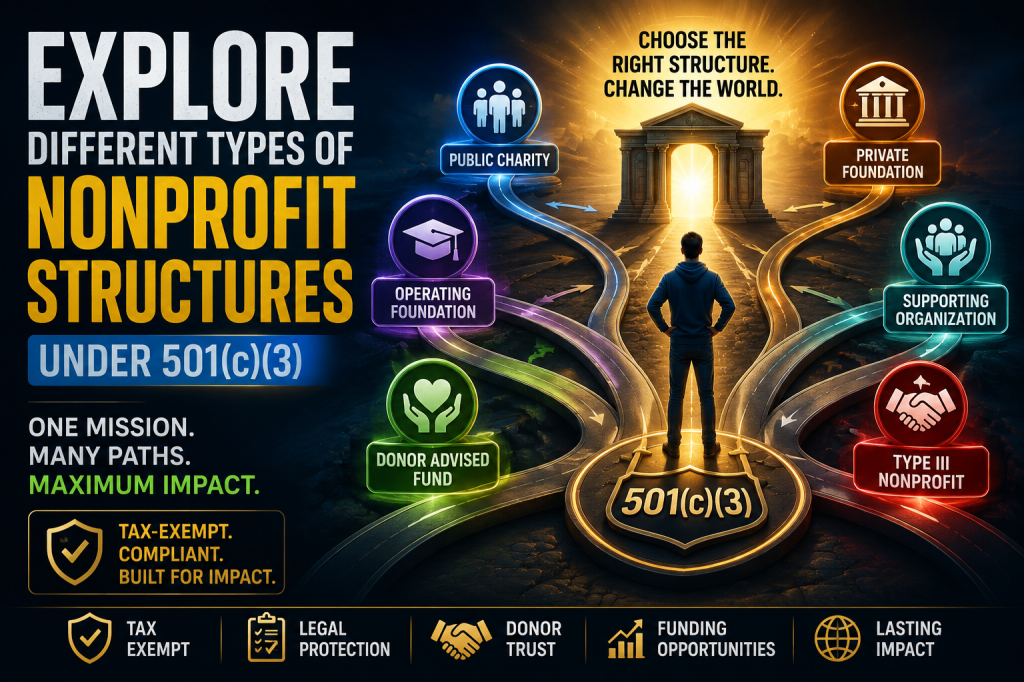
The Internal Revenue Code is a complex architecture. When you step into the world of tax-exempt organizations, you aren’t just “starting a non-profit.” You are selecting a tax classification that dictates your fundraising capacity, your board composition, and your relationship with the IRS.
This guide dismantles the technical barriers between Public Charities, Private Foundations, and Private Operating Foundations. Whether you are launching a global humanitarian mission or a niche non-profit magazine, the structure you choose today determines your survival tomorrow.
Table of Contents
- What is the fundamental difference between a Public Charity and a Private Foundation?
- What is a Private Operating Foundation (POF) and why does it exist?
- Who can legally operate these entities?
- How do tax deduction limits vary between these structures?
- Can a non-profit operate exactly like a for-profit business?
- When should you avoid a Private Foundation structure?
- What are the “Self-Dealing” and “Disqualification” rules?
- Which entity is best for starting a university or education center?
- Which structure works best for scholarship programs?
- Which entity is best for running a non-profit magazine?
- How can a foundation run alongside a for-profit business?
- What are the specific requirements to maintain tax-exempt status?
- What real-world cases and legal precedents define these entities?
- References & Sources
What is the fundamental difference between a Public Charity and a Private Foundation?
By default, the IRS considers every 501(c)(3) organization a private foundation unless it can prove it is a public charity. This distinction is governed by IRC § 509(a).
Public Charity (IRC § 509(a)(1) and (2))
A public charity receives a significant portion of its support from the general public or government units. To maintain this status, the entity must pass the “Public Support Test.”
Generally, at least one-third of total support must come from “public” sources (donors who give less than 2% of the total support, other public charities, or government grants).
- Logic: If the public funds you, the public will monitor you. Therefore, the IRS applies lighter oversight.
- Examples: Churches, hospitals, schools, and organizations like the American Red Cross.
Private Foundation (IRC § 509(a))
A private foundation is typically funded by a single individual, a family, or a corporation. Because they lack broad public oversight, the IRS imposes stricter regulations to prevent the founders from using the foundation as a private “piggy bank” or a tax-evasion vehicle.
- Logic: Without public donors watching the books, the IRS must step in with excise taxes and rigid distribution rules.
- Examples: The Bill & Melinda Gates Foundation, the Ford Foundation.
- Tip: Here is an easy way to remember the difference between a public nonprofit and a foundation:
- A private foundation is a grant-making entity where board members engage in two main activities: investing and grant-making. Foundations have to donate 5% of their fund to support public nonprofits (as grants or donations).
- Public nonprofits allow you to seek grants and donations from diverse sources (including private foundations) to operate a public-facing nonprofit (school, hospital, zoo, or store).
Now, let’s look at a hybrid nonprofit entity called the private operating foundation.
What is a Private Operating Foundation (POF) and why does it exist?
A Private Operating Foundation (POF) is a hybrid entity defined under IRC § 4942(j)(3).
Unlike a standard private foundation – which primarily gives money to other charities (grant-making) – a POF uses its funds to run its own programs. It has the funding profile of a private foundation (one donor) but the operational active nature of a public charity.
Why they exist:
They allow a wealthy donor to maintain control over the assets while actively engaging in a specific mission, such as running a museum, a research facility, or a library.
The “Income Test” for POFs:
To qualify, a POF must spend at least 85% of its “adjusted net income” or its “minimum investment return” (whichever is less) directly on the active conduct of its exempt activities. That can be tricky to compute, and not adhering to these will result in being reclassified to a private foundation, or in rare situations, a public nonprofit.
Who can legally operate these entities?
The “who” is less about identity and more about control and governance.
- Public Charities: Must have a diversified board of directors. Usually, a majority of the board must be “unrelated” (not family members or business partners). This ensures the mission serves a public interest rather than a private one.
- Private Foundations: Can be operated by a single person or a family. There are no “unrelated board member” requirements. This offers the founder total control over the vision and the investment strategy.
- Private Operating Foundations: Similar to private foundations, these can be tightly controlled by a small group of “disqualified persons” (donors, family members, or major contributors).
How do tax deduction limits vary between these structures?
The IRS rewards donors more for giving to public charities because those entities are perceived to have higher immediate social utility.
| Feature | Public Charity / POF | Private Foundation |
|---|---|---|
| Cash Donation Limit | 60% of AGI | 30% of AGI |
| Appreciated Assets (Stock) | 30% of AGI (Fair Market Value) | 20% of AGI (Cost Basis*) |
| Carryover Period | 5 Years | 5 Years |
*Note: Publicly traded stock given to a private foundation may sometimes be deducted at Fair Market Value under IRC § 170(e)(5).
Can a non-profit operate exactly like a for-profit business?
Yes, but with two major caveats: The Primary Purpose Test and UBIT (Unrelated Business Income Tax).
The Primary Purpose Test
Under Treasury Regulation § 1.501(c)(3)-1(e), an organization may operate a business as a substantial part of its activities if the operation of the business is in furtherance of the organization’s exempt purpose. If the business becomes the primary goal and the charity becomes secondary, the IRS will revoke the tax exemption.
Unrelated Business Income Tax (UBIT) – IRC § 511-513
If your non-profit sells a product or service that is not substantially related to its mission (e.g., a university running a commercial pizza parlor), the income is taxable at corporate rates.
- The Trap: If UBIT-generating income becomes “substantial” (often interpreted as 20%–30% of total revenue), the entity’s exempt status is in jeopardy.
When should you avoid a Private Foundation structure?
Do not choose a Private Foundation if:
- You want to solicit small donations from the public: Public donors cannot easily verify your “Public Support” status, and they get lower tax deductions.
- You want to avoid administrative costs: Private foundations must pay a 1.39% excise tax on net investment income (IRC § 4940) and file complex Form 990-PF returns.
- You want to engage in heavy lobbying: Private foundations are strictly prohibited from lobbying. Public charities, however, can make a 501(h) election to spend a limited portion of their budget on lobbying.
- You want to hire family members at high salaries: While possible, it triggers extreme IRS scrutiny regarding “Self-Dealing.”
What are the “Self-Dealing” and “Disqualification” rules?
Private Foundations are governed by a “minefield” of excise taxes designed to prevent “insider” benefits.
1. Self-Dealing (IRC § 4941)
Strictly prohibits almost any financial transaction between the foundation and “disqualified persons” (founders, board members, their families).
- Forbidden: Selling or leasing property, lending money, or furnishing goods/services between the donor and the foundation—even if the transaction is “fair” or benefits the foundation.
2. Failure to Distribute Income (IRC § 4942)
Private non-operating foundations must distribute approximately 5% of the fair market value of their non-charitable use assets (endowment) annually. If they fail to do so, they face a 30% tax on the undistributed amount.
3. Excess Business Holdings (IRC § 4943)
A private foundation and its disqualified persons cannot own more than 20% of a for-profit business. This prevents using a foundation to maintain control of a family corporate empire.
Which entity is best for starting a university or education center?
The Winner: Public Charity (IRC § 170(b)(1)(A)(ii)).
Schools and universities are “per se” public charities. They do not need to pass the complex mathematical Public Support Test because their inherent nature as an educational institution with a regular faculty, curriculum, and enrolled student body grants them public status.
Why?
- It allows for massive capital campaigns (higher tax deductions for wealthy alumni).
- It allows the institution to receive government grants and federal student aid (FAFSA) (may have additional registration requirements).
- It avoids the 5% mandatory payout rule, allowing the university or online education center to grow its endowment indefinitely.
Which structure works best for scholarship programs?
The Winner: Private Operating Foundation (if self-funded) or Public Charity (if community-funded).
If you are a high-net-worth individual wanting to award scholarships:
- The Problem: A standard Private Foundation must get prior IRS approval for its scholarship grant-making procedures under IRC § 4945(g). Failure to do so results in “taxable expenditures.”
- The POF Advantage: If the scholarships are part of an active program (e.g., the foundation also provides mentorship, tutoring, or research facilities), the POF structure allows the donor to stay involved while enjoying public charity tax deduction limits.
Which entity is best for running a non-profit magazine, podcast, or workshops?
The Winner: Public Charity (501(c)(3)).
A non-profit magazine is a powerful vehicle for authority and thought leadership. However, it must be “educational” rather than “commercial.”
The Strategy:
- Content: Must serve an educational purpose (e.g., scientific research, arts, public policy).
- Monetization: Subscription fees and advertising are allowed, but they must be secondary to the mission.
- The “Commerciality Doctrine”: If your magazine looks, acts, and is priced exactly like Vogue or The Economist, the IRS will argue you are a commercial enterprise masquerading as a charity. Ensure you focus on education, consumer protection, access to justice, equality, news, or scam “busting” content to separate your mission from commercial magazines and publications.
What are the specific requirements to maintain tax-exempt status?
Compliance is not a suggestion; it is a statutory mandate.
- Form 990 / 990-PF: The annual “public report card.” Private foundations file the “PF” version, which is much more intrusive regarding investment assets and “disqualified persons.”
- Conflict of Interest Policy: Mandatory for public charities to prove they aren’t funnelling money to board members.
- Public Inspection: You must provide your last three years of tax filings and your original application (Form 1023) to anyone who asks.
- No Private Inurement: No part of the net earnings of a 501(c)(3) may “inure” to the benefit of any private shareholder or individual. This is the “death penalty” rule. If you pay your CEO $2 million for a $200k job, the IRS will shut you down.
What real-world cases and legal precedents define these entities?
1. The Getty Trust (Private Operating Foundation)
The J. Paul Getty Trust is one of the world’s wealthiest POFs. It doesn’t just give money to museums; it is the museum. By operating the Getty Center and Getty Villa, it satisfies the POF requirements of spending its income on its own exempt activities, allowing it to maintain a massive endowment while being treated like a public charity for tax deduction purposes.
2. United Cancer Council, Inc. v. Commissioner (1999)
This case defined the limits of “Private Inurement.” The UCC entered into a contract with a professional fundraiser where the fundraiser kept 90% of the donations. The IRS tried to revoke their status. The court eventually ruled that while it was a “bad deal,” the fundraiser wasn’t an “insider” (initially). This case forced the IRS to create “Intermediate Sanctions” (IRC § 4958), allowing them to fine individuals instead of just revoking the charity’s status.
3. Better Business Bureau of Washington, D.C., Inc. v. United States (1945)
The Supreme Court ruled that if an organization has a “single non-educational purpose that is substantial in nature,” it cannot be a 501(c)(3). This is the bedrock of the “Exclusivity Rule”—your organization must be operated exclusively for exempt purposes.
4. The “Newman’s Own” Exception (The Philanthropic Business)
For years, the 20% “Excess Business Holdings” rule made it hard for businesses to give 100% of profits to charity. In 2018, the “Philanthropic Enterprise Act” was passed, creating an exception to IRC § 4943. It allows a private foundation to own 100% of a business if all profits go to the foundation and the business is independently managed.
Please read the articles covering “Hybrid Entities,” which cover Newman’s Own Exception and Hybrid Operating Structures that enable you to run a nonprofit and for-profit in tandem.
Pros and Cons Summary
Public Charity
- Pros: Highest tax deduction limits; no excise tax on investment income; eligible for all grants; public trust.
- Cons: Must constantly fundraise from the public; “Public Support Test” is a math nightmare; high transparency/public board requirement.
Private Foundation
- Pros: Total control by founder/family; no public fundraising required; can focus solely on grant-making.
- Cons: Stricter “Self-Dealing” rules; 5% annual payout requirement; 1.39% excise tax; lower tax deductions for donors.
Private Operating Foundation
- Pros: Public charity tax deduction limits for donors; allows founder control; can run own programs.
- Cons: Must pass complex “Income” and “Asset” tests annually; cannot be a “passive” grant-maker.
Final Strategic Checklist for Founders
- If you have $10M+ and want to control the legacy: Start a Private Foundation.
- If you want to build a movement and ask the world for money: Start a Public Charity.
- If you are a scientist or artist wanting to run your own lab or gallery with your own money: Start a Private Operating Foundation.
- If you want to protect consumers or advocate for policy: Ensure you understand the 501(h) election to avoid the “lobbying death trap.”
The choice between these entities isn’t just about tax—it’s about the power dynamic of your mission. Do you want to be a solo benefactor, or the leader of a public institution?
Choose wisely; the IRS is always reading your 990. If you have some ideas but are not sure which structure may be right for you, feel free to comment below or schedule a pro bono session through our research hotline to have our researchers point you to the right resources.
That’s it for now, talk soon.
Cheers,
Sid Peddinti, Esq.
Nonprofit & Tax Lawyer and Board Advisor. Legal Publisher. AI Innovator. TEDx Speaker.
References & Sources
- Internal Revenue Code (IRC) § 501(c)(3): Exemption from tax on corporations, certain trusts, etc.
- IRC § 509(a): Definition of private foundation vs. public charity.
- IRC § 4941: Taxes on self-dealing.
- IRC § 4942: Taxes on failure to distribute income.
- Treasury Regulation § 1.501(c)(3)-1: Organizational and operational tests.
- IRS Publication 557: Tax-Exempt Status for Your Organization.
- The Philanthropic Enterprise Act of 2018: Exception to excess business holdings.
- Case Law: United Cancer Council, Inc. v. Commissioner, 165 F.3d 1173 (7th Cir. 1999).
- Case Law: Better Business Bureau v. United States, 326 U.S. 279 (1945).
 The Nonprofit magazine™
Leave a comment