By: Sid Peddinti, Esq.
Nonprofit & Tax Lawyer. Forensic Tax Researcher. Legal Publisher.
Folks,
For many successful business owners, professionals, investors, and families, the conversation about philanthropy begins with the wrong question.
The usual question is: How much will I have to give away?
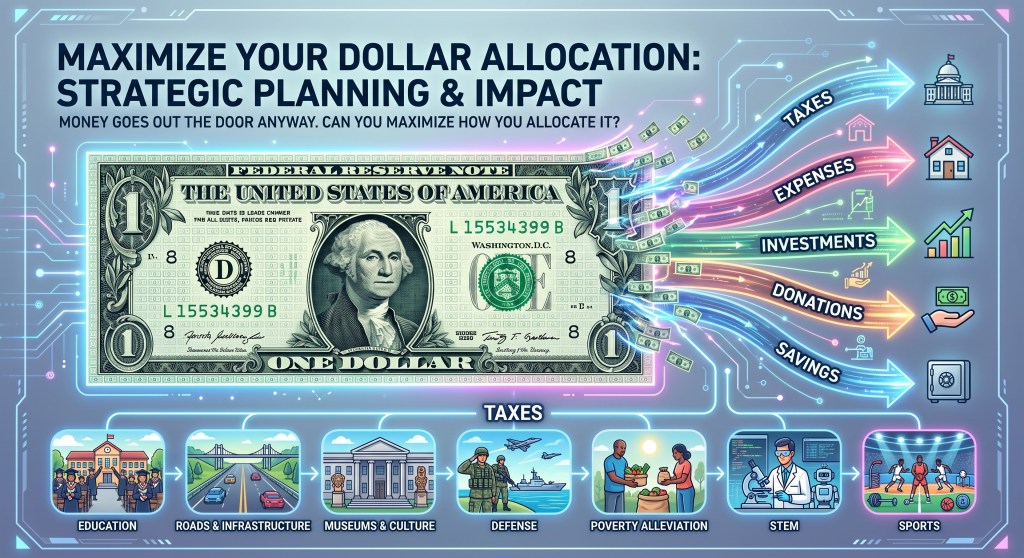
A more useful question may be: Where is the money going anyway?
Income rarely remains untouched. It moves through a household and business ecosystem. Some goes to federal, state, and local taxes. Some pays employees, professional fees, insurance, housing, education, travel, and other expenses. Some is invested. Some is donated. Some is consumed. The remainder becomes savings or additional investment capital.
Once this is understood, philanthropy begins to look less like an isolated act of “giving money away” and more like another decision about the allocation of capital.
For families that already intend to make substantial charitable contributions, a private foundation can change the way that portion of their wealth is organized. Instead of making unrelated donations year after year, a family may choose to dedicate assets to a charitable institution capable of investing assets, making grants, conducting qualifying charitable activities, and potentially continuing its mission across generations.
The donated assets are no longer the donors’ personal assets. A private foundation does not allow a family to keep donated money for itself. Once contributed, the assets belong to the private foundation and are subject to different rules and regulations that govern foundations, primarily covered by §4940-4945 of the tax code.
But the foundation can provide something an ordinary series of charitable checks generally cannot: an institutional structure through which charitable capital can be managed and deployed over time. [1][2]
Start With a Simple Example: $1 Million
Consider a simplified example of an individual or family generating $1 million of annual income. Please note that there is no minimum threshold to start a foundation, but we typically explore this option for clients if you are paying close to $100,000 a year in taxes, or AGI around $400,000 per year or more. We’ll explore the $1M income example to keep the math simple.
Income: $1,000,000 a year. Assume taxes are 35%.
The money might ultimately be allocated as follows:
- $350,000 toward federal, state, and other taxes;
- $200,000 toward business, household, professional, and lifestyle expenses;
- $200,000 toward investments;
- $75,000 toward charitable contributions; and
- $175,000 retained.
These numbers are purely illustrative. Actual taxes and deductions depend on numerous facts, including the taxpayer’s filing status, state of residence, sources of income, business structure, deductions, investment activity, charitable contributions, and other circumstances.
The point is not the exact allocation.
The point is that $1 million coming in does not mean $1 million remains available for personal accumulation. Most of it will be allocated somewhere. This happens whether or not the family has a philanthropic strategy.
The Money Is Already Being Allocated
Taxes are perhaps the most obvious example.
Individuals and businesses pay taxes, and governments use public revenue to finance public functions. Those functions include education, infrastructure, healthcare programs, scientific research, public safety, workforce initiatives, social services, and grants or contracts involving nonprofit organizations.
In other words, successful taxpayers are already participating indirectly in the financing of countless public and social priorities. That is not an argument against taxation. Taxes and private philanthropy serve different functions.
It does, however, raise an interesting question.
If a family is already going to dedicate a portion of its wealth to charitable purposes, should that philanthropy consist entirely of individual donations, or should some of it be organized into a multi-generational charitable institution?
That is where the private foundation becomes relevant.
What Changes With a Private Foundation?
Consider another hypothetical allocation.
A family earns $1 million and decides to make philanthropy a significant part of its long-term wealth strategy. During the year, it contributes $300,000 to a properly established private foundation.
Its simplified allocation might look something like this:
AGI: $1,000,000.
- $200,000 contributed to the private foundation;
- New AGI: $800,000. Assume taxes are still 35%
- $280,000 paid in taxes;
- $200,000 allocated to expenses;
- $150,000 placed into personal investments; and
- $170,000 retained.
Federal charitable deductions are governed principally by Internal Revenue Code §170, and applicable deduction limitations depend on several factors, including the type of charitable organization receiving the contribution and the type of property donated. The IRS explains that contributions to many private foundations are generally subject to a 30 percent adjusted-gross-income limitation, while certain contributions of capital-gain property may be subject to a 20 percent limitation. Other charitable organizations can be subject to different limits. [3][4]
The tax calculation therefore has to be performed independently for each donor. But the broader economic concept remains useful.
The family has decided that a portion of its wealth will no longer be held for personal use – it will become charitable and social capital. In the words of Andrew Carnegie: All excess income should be held and managed for the benefit of society.
The Most Important Rule: The Money Is No Longer Yours
This distinction cannot be overstated.
A contribution to a private foundation is not the equivalent of transferring money from a checking account into another investment account controlled for the family’s personal benefit.
The foundation is a separate charitable organization. The money must remain dedicated to charitable purposes. You cannot just withdraw money from the foundation and use it for personal expenses, investments, or emergencies. That money belongs to the foundation, but you are allowed to draw a “reasonable salary” for your work in the foundation. In terms of decision-making, it would be no different than running a C-corporation or an LLC – it is a separate taxpayer and is responsible for its own income, expenses, and decisions.
Private foundations are subject to a detailed statutory framework designed in part to prevent charitable assets from being diverted for improper private purposes. Among these rules are:
- IRC §4941 governing self-dealing
- §4942 governing failures to make required distributions,
- §4943 governing excess business holdings,
- §4944 governing jeopardizing investments, and
- §4945 governing taxable expenditures. [5]
These restrictions matter.
A donor cannot contribute $200,000, claim a charitable deduction, and then continue treating the $200,000 as personal money. It cannot be used to pay a family’s mortgage, vacations, ordinary household expenses, or other personal obligations.
The donor and his/her family should reevaluate their expenses and allocations before redirecting a portion of their pre-tax income to their foundation to ensure it is a strategic, calculated, and irreversible move. As mentioned earlier, a wise approach would be treating this like another company – an entity that has a separate and distinct identity from you and your family.
Donating Money Does Not Necessarily Mean Spending It All Immediately
This is where private foundations become particularly interesting from a long-term planning perspective.
A private nonoperating foundation generally has an annual distributable amount calculated using its minimum investment return and statutory adjustments.
The IRS describes the minimum investment return as generally 5 percent of the fair market value of assets not used directly for charitable purposes, reduced by certain acquisition indebtedness. The actual distributable amount involves additional adjustments and should not simply be described as “5 percent of the foundation.” [6][7]
This means that a foundation can generally maintain and invest a substantial portion of its charitable assets while satisfying its charitable distribution obligations.
Suppose a foundation receives $200,000 (from the example above). Conceptually, the foundation might maintain much of that capital in an investment portfolio while making qualifying distributions over time.
Qualifying distributions can include amounts paid to accomplish charitable, educational, scientific, literary, religious, and other recognized public purposes. They can also include certain expenditures for assets used directly in carrying out charitable purposes and, under specific circumstances, qualifying set-asides. [8]
The foundation therefore does not necessarily function like a pipe through which $200,000 enters on Monday and $200,000 must leave on Tuesday to qualified nonprofits.
It can function more like a reservoir of permanently charitable capital.
- The assets remain charitable.
- They may be invested.
- The investments may generate returns.
- The foundation makes qualifying distributions.
- Those distributions support charitable activities.
- And the remaining charitable assets may continue supporting the mission in future years.
From Charitable Giving to Charitable Capital
This leads to an important distinction between donating and institution building. Traditional philanthropy is often transactional:
- A university requests a donation. A family contributes.
- A local nonprofit holds a fundraiser. The family buys a table.
- A disaster occurs. The family writes a check.
- A scholarship campaign launches. The family contributes again.
- Each of these actions can be worthwhile.
A foundation simply introduces another possibility.
Instead of asking only, “Which organizations should we donate to this year?” the family can begin asking:
What problem do we want to help solve over the next 20 years?
That question changes the nature of philanthropy.
A foundation can develop a mission, establish grantmaking criteria, research organizations, measure outcomes, develop partnerships, create charitable programs, support research, finance scholarships, and establish long-term priorities.
The family is no longer merely responding to requests for money. It is developing a philosophy for deploying charitable capital.
The Foundation Can Also Become an Investment Institution
There is another obvious point that deserves greater attention. Charitable assets do not necessarily have to remain idle while waiting to be distributed.
Private foundations commonly hold investment assets, and the federal tax system expressly contemplates investment activity. Private foundations are generally subject to an excise tax on net investment income under IRC §4940, while other provisions regulate investments that jeopardize the carrying out of the foundation’s exempt purposes. [5]
This creates an entirely different perspective on a charitable contribution. The donor may give up personal ownership of the capital, but the charitable institution can potentially invest that capital and use future returns to help finance its mission.
Over a sufficiently long period, this can give one pool of charitable capital multiple lives.
- It can produce investment returns.
- Those returns can help fund grants.
- The grants can support organizations.
- Those organizations can create programs.
- Those programs can affect communities.
Meanwhile, capital remaining within the foundation may continue supporting future charitable work. That is not simply giving money away. It is capitalizing a charitable institution – one that carries your family or business name.
A Foundation Can Become a Classroom for the Next Generation
For families concerned about generational wealth, another opportunity emerges. The conversation about inheritance usually focuses on assets.
- How much will the children receive?
- How will trusts be structured?
- Who receives the business?
- Who receives the investments?
- Who receives the real estate?
But families can also transfer something considerably harder to quantify: responsibility.
A properly governed family foundation can create opportunities for younger generations to learn about charitable decision-making, governance, budgeting, investment oversight, due diligence, nonprofit organizations, community needs, and stewardship.
Imagine a family meeting in which the next generation reviews several organizations seeking grants.
- Which organization has the strongest program?
- Which has measurable results?
- Which community needs the most help?
- Should the foundation make one $100,000 grant or ten $10,000 grants?
- Should it support an established institution or an innovative new organization?
- Should a grant be renewed?
- Did last year’s grant accomplish what was expected?
- How should the foundation’s investment assets be managed?
- How many projects have we funded?
- How many people have we helped?
- What STEM programs can we support this year?
Those are very different conversations from simply telling children to be responsible with an inheritance. The foundation can give them something real to steward. The foundation can hire the children to perform investments, management, and operational functions, for which they can be paid a reasonable salary.
The most important part: The $200,0000 that’s fueling the foundation, investments, and charitable work would have gone out the door anyway. The same funds are now “teaching, preparing, and coaching” the next generation to be responsible stewards of wealth.
The Family Can Build Wealth and Build Impact
None of this requires abandoning personal wealth creation. A family can continue owning businesses. It can invest personally. It can acquire real estate. It can save for retirement. It can travel. It can support children and grandchildren. It can pursue entrepreneurial opportunities. And separately, it can determine how much wealth it wishes to dedicate to charitable purposes.
That distinction is essential. The goal is not necessarily to replace personal wealth with philanthropy. It is to recognize that personal capital and charitable capital can exist alongside one another, each serving a different purpose.
One builds financial security and opportunity for the family. The other can build opportunity for people beyond it.
The Return Is Different
A conventional investment is generally judged by its financial return. A foundation requires a broader definition.
- The return might be a scholarship recipient who graduates from college.
- It might be a workforce program that helps 100 people obtain better jobs.
- It might be medical research.
- It might be financial education.
- It might be a new community center.
- It might be support for an organization that otherwise would have disappeared.
- It might be a family spending 30 years working together around a shared mission.
- It might be grandchildren learning that wealth creates obligations as well as opportunities.
- It might be a community that remembers a family not simply for what it accumulated, but for what it helped build.
Those results do not appear on the family’s personal balance sheet. But they are results nonetheless. This model helps you and your family incorporate a double bottom line approach where financial success is measured alongside social and humanitarian impact – with the same income and assets, just reallocated differently.
The Real Question Is Where the Money Goes
The foundation conversation becomes much clearer when it is removed from the narrow frame of “How much money am I giving away?”
Money is constantly leaving.
- Taxes.
- Expenses.
- Consumption.
- Travel.
- Education.
- Investments.
- Children.
- Charitable donations.
Eventually, nearly every dollar accumulated during a lifetime will be spent, invested, transferred, donated, or inherited. The more interesting question is what happens to it along the way.
For some families, direct charitable donations will remain the simplest and most appropriate solution.
Others may prefer donor-advised funds, charitable trusts, public charities, private operating foundations, private nonoperating foundations, or combinations of different philanthropic structures.
But families capable of committing meaningful resources to philanthropy should at least understand the distinction between making charitable donations and building charitable infrastructure.
A private foundation does not allow someone to give money away while secretly keeping it. It does something more legitimate and potentially more enduring. It allows capital that a family has genuinely committed to charity to be organized, governed, invested, and deployed around a mission.
That changes the question.
Instead of asking only:
How much can we keep?
A family can also ask:
How much do we need personally, how much do we want to invest for our future, and how much are we willing to permanently commit toward building something that outlives us?
Because the money will eventually go somewhere. The question is what kind of footprint it leaves behind.
Thank you,
Sid Peddinti, Esq.
Nonprofit & Tax Lawyer, TEDx Speaker, Forensic Legal Researcher, Legal Publisher.
References
[1] Internal Revenue Service, Publication 557: Tax-Exempt Status for Your Organization, discussion of private foundations and private operating foundations. (IRS)
[2] Internal Revenue Service, Qualifying Distributions: In General, explaining expenditures and distributions that can constitute qualifying distributions by a private foundation. (IRS)
[3] Internal Revenue Service, Charitable Contribution Deductions, explaining deductibility, qualified organizations, property contributions, and percentage limitations applicable to charitable contributions. (IRS)
[4] Internal Revenue Service, Publication 526: Charitable Contributions, explaining the 60%, 50%, 30%, and 20% AGI limitations and special rules applicable to different organizations and types of contributed property. (IRS)
[5] Internal Revenue Service, Instructions for Form 990-PF, discussing the statutory private-foundation framework, including IRC §§4941–4945 and the requirements imposed on private foundations. (IRS)
[6] Internal Revenue Service, Minimum Investment Return, explaining the general 5 percent minimum-investment-return calculation for private foundations. (IRS)
[7] Internal Revenue Service, Tax on Private Foundation Failure to Distribute Income: Distributable Amount, explaining that the distributable amount begins with the minimum investment return and is subject to additional statutory adjustments. (IRS)
[8] Internal Revenue Service, Taxes on Failure to Distribute Income: Private Foundations, explaining annual distribution requirements, qualifying distributions, certain set-asides, and carryforwards of excess qualifying distributions. (IRS)
This article is intended for educational purposes and provides a conceptual illustration rather than individualized legal, tax, investment, or financial advice. Private-foundation planning depends on the donor, type of assets contributed, foundation classification, charitable objectives, applicable deduction limitations, and other facts. Nothing in this article should be construed as legal, tax, investment, or financial advice. Human and AI generated content.
 The Nonprofit magazine™
Leave a comment