Executive Summary:
A Private Family Foundation, governed by IRC §501(c)(3) and §509(a), transforms surplus capital into a perpetual engine for societal transformation. By bypassing capital gains and estate taxes, families utilize a disciplined 5% annual payout (IRC §4942) to fund social work, effectively “doing the government’s work” with superior private-sector efficiency, while institutionalizing family values across generations.
1. The Philosophical & Psychological Awakening: Beyond Hedonic Adaptation
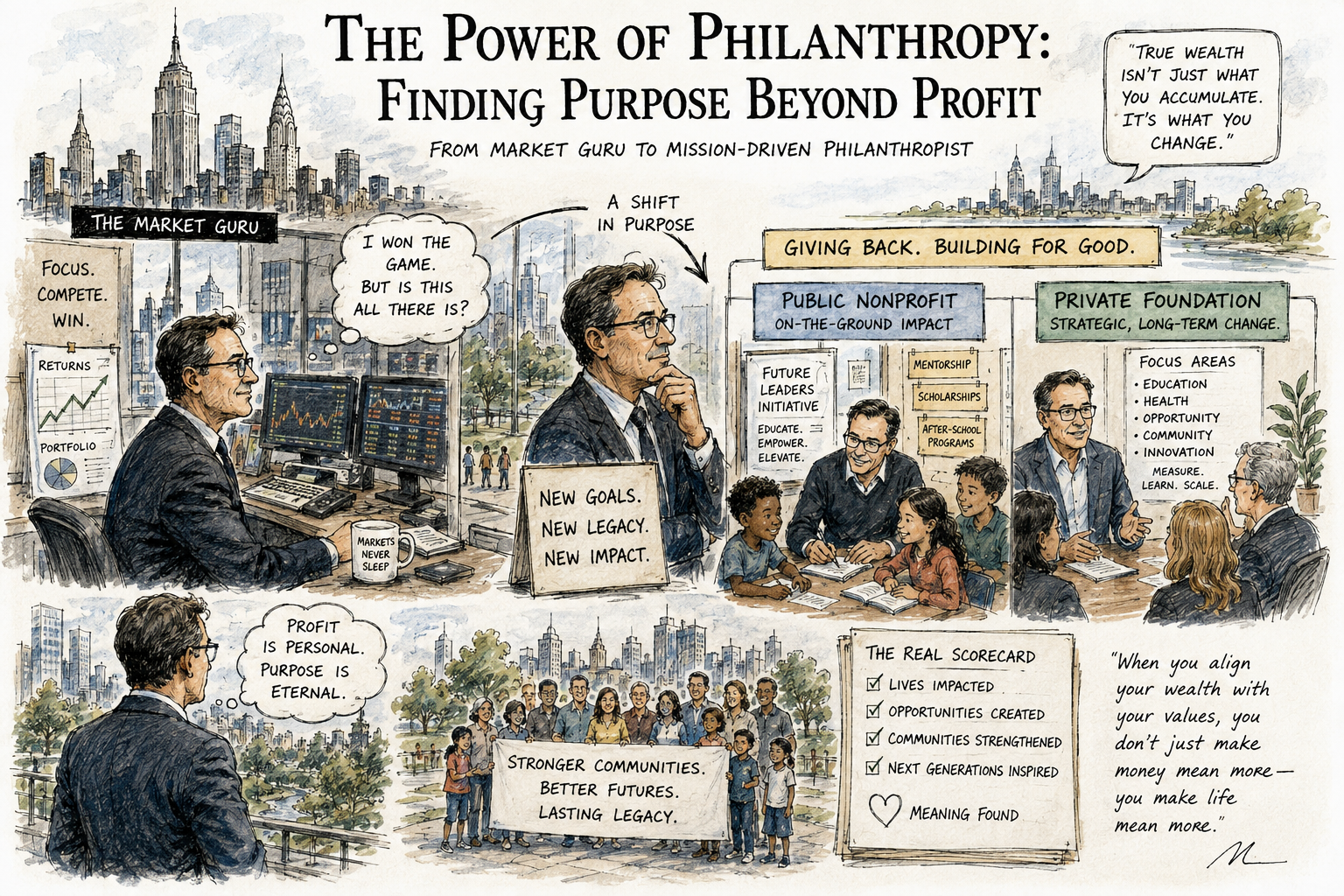
For the High-Net-Worth and Ultra-High-Net-Worth (UHNW) individual, the accumulation of capital eventually reaches a point of diminishing psychological returns, often referred to as the “hedonic treadmill.” Once financial security is absolute, the pursuit of the next million often yields less satisfaction than the first thousand. This “meaning vacuum” is where the Family Office Philanthropic Architect intervenes. The transition from Success to Significance requires moving assets from a personal balance sheet to a social-impact vehicle.
Psychologically, a foundation serves as a “Moral North Star.” It provides a neutral ground for family members—often divided by differing professional interests—to unite under a shared mission. By funding happiness through others’ upliftment, the donor experiences a “Warm Glow” effect that is neurologically more durable than the dopamine spike of luxury acquisition. You are not merely “giving money away”; you are purchasing a legacy of purpose that immunizes the next generation against the “affluenza” of unearned wealth.
2. Institutional Architecture: Private Foundation vs. Public Charity
The sophisticated family office must distinguish between the two primary vehicles of the Internal Revenue Code (IRC). Understanding this dichotomy is essential for strategic planning.
The Private Foundation (The Passive Endowment Model)
Under IRC §509(a), a PF is typically funded by a corporation, a single individual, or a family rather than the general public.
- Control: The family retains 100% control over the board and investment decisions.
- The 5% Rule: To maintain tax-exempt status, the foundation must distribute approximately 5% of its average investment assets annually in the form of qualifying grants or donations (IRC §4942).
- Investment Focus: The remaining 95% of the corpus grows in a tax-exempt setting, minus a “flat” excise tax of 1.39% on net investment income (income from investments) under IRC §4940.
The Public Charity (The Active Execution Model)
By contrast, a public 501(c)(3) must pass the “Public Support Test,” meaning it receives a substantial portion of its funding from the general public – not from one corporation, individual, or a family.
While it offers higher tax deduction limits (up to 60% of Adjusted Gross Income for cash), it requires public accountability and lacks the absolute family autonomy of a PF. You typically need a board member who is not related by blood or marriage, an independent person capable of ensuring the nonprofit funds are being handled according to the law (no insider trading).
Which “Nonprofit” Should You Choose?
The answer depends on your goals.
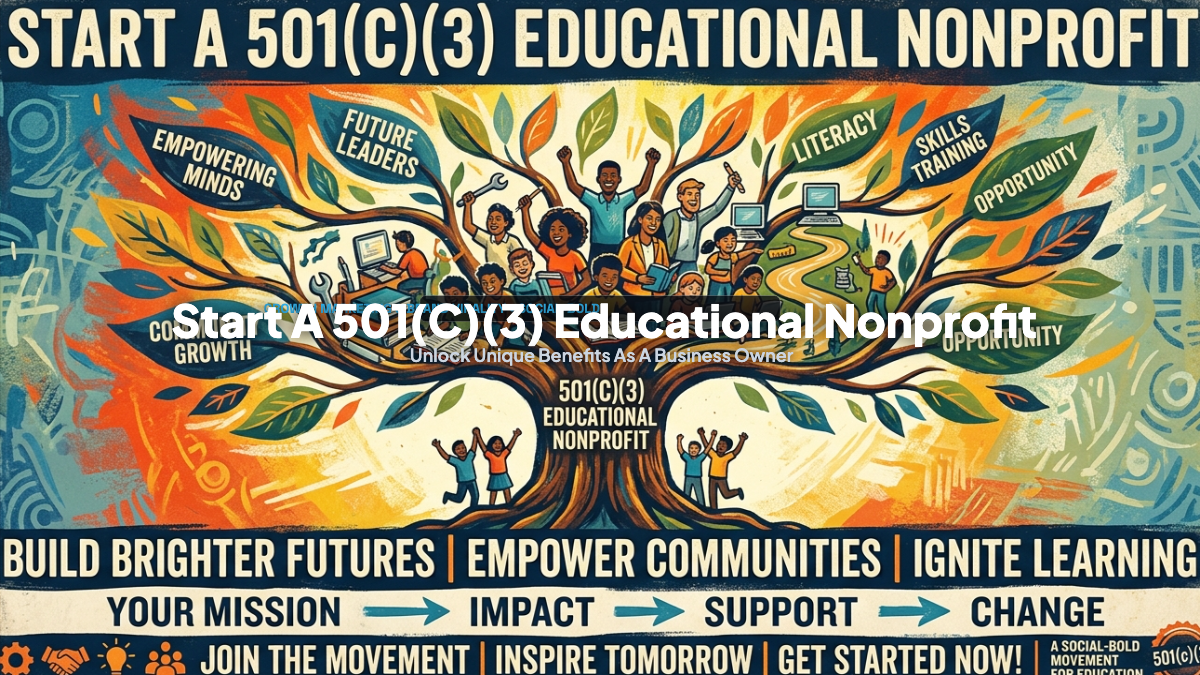
If you want to engage in public-facing activities, and you need public support and funding to advocate for your cause, the public nonprofit is the ideal model.
If you want to redirect a portion of your pre-tax income every year to your own foundation, and you’re looking to take advantage of the income tax, capital gains tax, estate and gift tax, and probate-bypassing benefits, and use those donated cash or assets to fuel the causes you care about through grants and donations, then the private foundation is the better option.
Both entities serve different purposes; many entrepreneurs incorporate both of them. In the public nonprofit, you seek public funding or generate revenue through program-related activities. In the private foundation, you use your own pre-tax income and assets to create a charitable investment fund that can fuel other nonprofits.
That’s the cycle of “strategic philanthropy”, and that’s where the “family office” structure comes into play for HNW and UHNW individuals, where layering and alignment between all the for-profit, tax-exempt, and estate planning documents becomes important.
3. Strategic Harvest of Chosen Benefits
The decision to formalize philanthropy is as much a financial strategy as it is a moral one. The benefits are fourfold, spanning the tangible and the intangible.
I. Tax Optimization & Capital Preservation
The foundation is a premier tool for “Estate Freezing.” By transferring highly appreciated assets (like pre-IPO stock or real estate) to a foundation, the donor:
- Bypasses Capital Gains Tax: The foundation can sell the asset and reinvest 100% of the proceeds without a tax haircut.
- Secures an Immediate Income Tax Deduction: Generally up to 30% of AGI for appreciated assets and 20% for cash (IRC §170(b)).
- Eliminates Estate Tax: Assets inside the foundation are removed from the donor’s taxable estate, effectively avoiding the 40% federal estate tax.
II. Brand Recognition & Reputational Capital
In the modern economy, “Social Capital” is a currency as valuable as liquidity. A foundation provides Reputational Capital through naming rights on hospitals, universities, and museums. This creates an “ESG Credibility” shield that protects the family’s business interests, providing a “halo effect” that facilitates high-level civic networking and global diplomatic access.
III. Goodwill & Moral Legacy: The 100-Year Vision
A foundation is perpetual. While a trust eventually dissolves, a foundation carries the founder’s name and values into the 22nd century. It serves as a Character Mentorship platform; by involving children and grandchildren in grantmaking decisions, you teach them stewardship, financial literacy, and empathy. You are passing on your values, which ensures the survival of your valuation.
IV. Measurable Social Impact: Funding the Work the Government Can’t Do
Private foundations are the “R&D labs” of society. Unlike the government, which is slowed by bureaucracy, a foundation can pivot instantly to fund humanitarian crises, medical research, or social entrepreneurship. Once the paperwork is approved, the bank accounts are set up, and the nonprofit causes that you want to donate to have been chosen, it takes minutes to go from “pre-tax income >> foundation >> grants or donations received by the church, museum, university, or other nonprofit that you want to fund”.
You are not just “paying taxes”; you are directing your capital toward specific, measurable “Community ROI,” such as the number of lives saved or students educated.
4. The Lifecycle and Execution Roadmap
Starting a foundation is a once-in-a-lifetime structural event followed by a perpetual cycle of growth and impact.
“The founder builds the vessel; the family steers the course; the community reaps the harvest.”
Step 1: Registration and Legal Birth
The process begins by incorporating as a non-profit corporation or a charitable trust at the state level. You then apply for federal tax-exempt status via IRS Form 1023. This requires a defined “Mission Statement” and “Bylaws” that prevent Self-Dealing (IRC §4941)—the illegal practice of using foundation assets for personal benefit.
Step 2: Investing from the Corpus
How you invest within the foundation is critical. While traditional investing focuses on maximizing returns to fund the 5% payout, modern family offices utilize Mission-Related Investments (MRIs) and Program-Related Investments (PRIs). A PRI is a loan or equity investment that counts toward your 5% distribution requirement as long as its primary purpose is charitable (e.g., low-interest loans for affordable housing). This allows the foundation to recycle its capital: give a loan, get it back, and give it again.
Step 3: Grantmaking and Donation Strategy
Grants are the lifeblood of the foundation. The board (the family) meets quarterly to review “Grant Dockets.” Effective grantmaking requires due diligence:
- Reviewing the Form 990 of potential grantees.
- Issuing “Grant Agreements” that mandate impact reporting.
- Engaging in “Catalytic Philanthropy”—providing the first capital that encourages others to follow.
Conclusion: The ROI of Infinite Impact
The set-up fee for a foundation is a one-time investment; the recurring compliance costs are a fraction of the tax savings. However, the true Return on Investment (ROI) is not found in the spreadsheet—it is found in the transformation of your family’s identity. You move from being “The Family with the Fortune” to “The Family that Changed the World.”
By using the foundation to do the “government’s work” directly, you exercise your sovereign right to shape the future. You are funding social work, human dignity, and public progress with a level of precision the state can never match. This is the ultimate expression of financial freedom: the power to convert capital into a living, breathing, and eternal legacy of goodwill.